
| On Friday evening, 1st of May, a new version of the Minddistrict platform will go into production. In this release note, you'll find all updates. Enjoy the new version of Minddistrict! |
| Do you have questions about the Minddistrict platform or app? Visit our online support site! |
TABLE OF CONTENTS
Platform
Related person functionality: Therapists can invite related person and start a conversation
This update is relevant for therapists, secretaries, clients and related persons
We are currently expanding the related person functionality to further support the involvement of family members or other related persons in the treatment of a client. In doing so, we are strengthening integrated care, increasing the involvement of family members and other related persons and ensuring continuity of care outside the treatment room.
With the expanded functionality:
- Related therapists and secretaries can invite a client’s related person
- The related person will then receive an email with instructions on how to log in to the account
- The therapist can start a conversation with the related person.
Related person accounts created by the client themselves remain hidden from the therapist to ensure privacy. When a therapist invites a related person who has already been added by the client, that person becomes visible to the therapist.
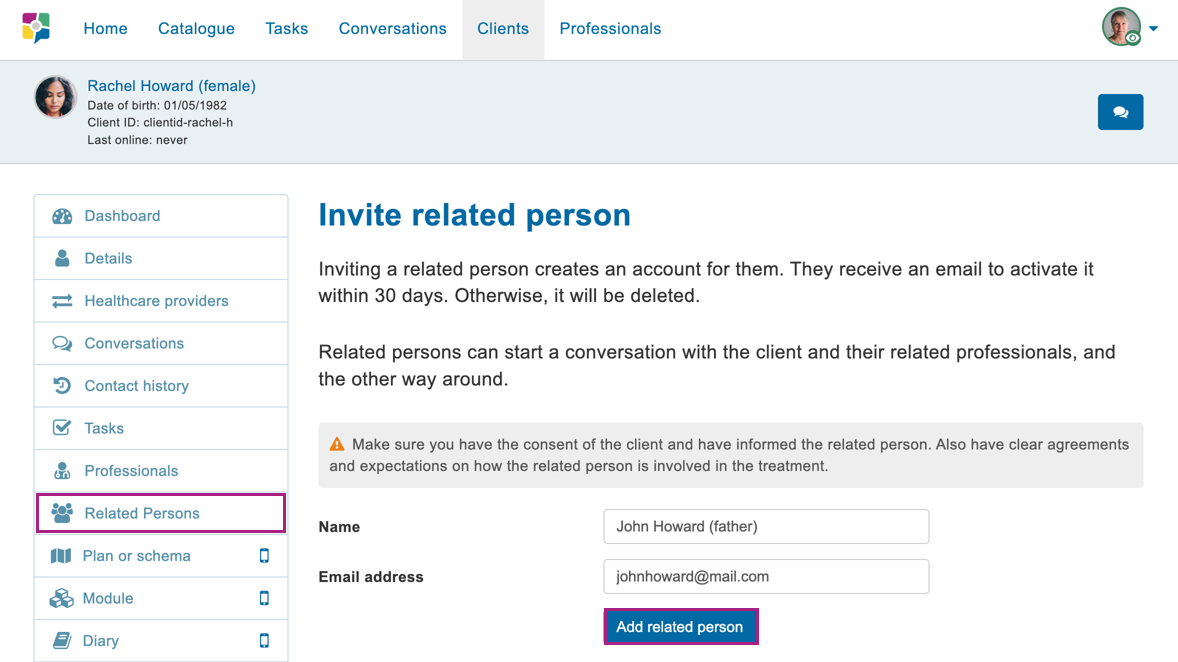 | 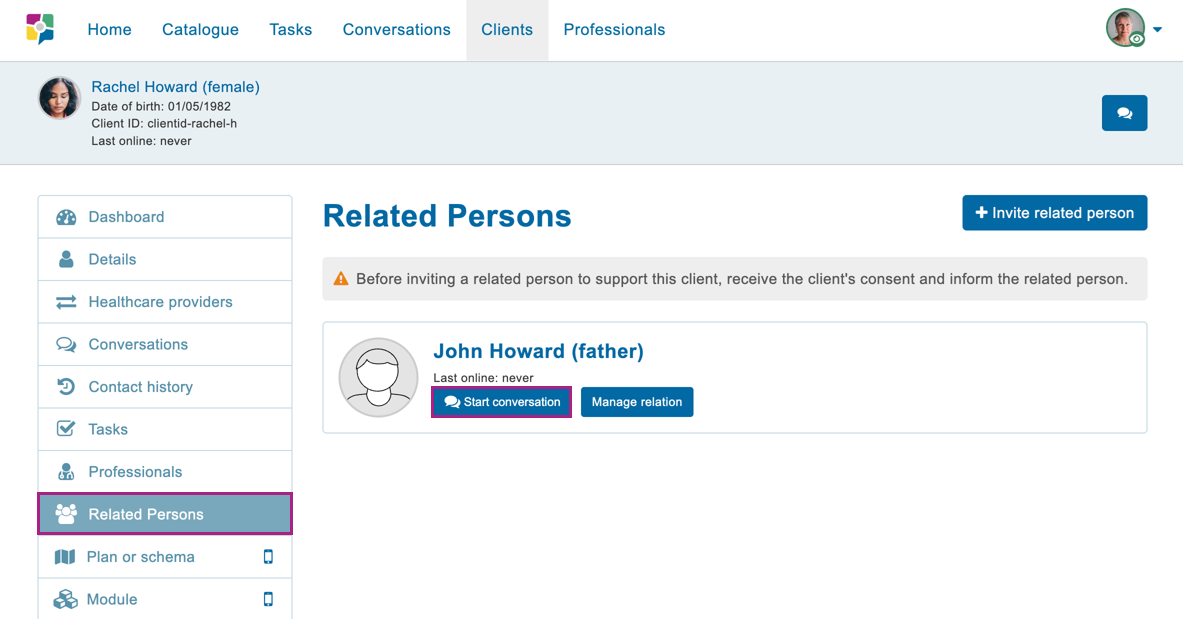 |
Therapist can invite a related person | Therapist can start a conversation with a related person |
Therapists can delete a related person accounts that they created. The account remains active for the related person, but the connection between the therapist and the related person is severed.
Therapists must always ask the client for permission before inviting a related person.
In the configuration 'Related persons' the application manager can enable or disable the option for therapists to invite related person. The option is disabled by default.
Network care: Clients can share their tool overview with other platforms
This update is relevant for therapists and clients
Network Care enables clients to navigate seamlessly within a network of care providers by organizing the care surrounding the client. This promotes greater autonomy, continuity, and connection in treatment.
In collaboration with our partner Evie, we have implemented the Network Care functionality, which allows a client to share activities in the tools with another Minddistrict platform and the associated care providers, so that the care provider can use that information to strengthen the therapeutic relationship.
With Network Care:
- The client can view a list of other connected care providers where they also have a Minddistrict account;
- The client can quickly navigate to those connected care providers;
- The client can share an overview of tools, including their status and assignment date. If the client chooses to share this with the related therapists, they will be informed about the client’s activities and progress on the other Minddistrict platform.
- The care provider can request access to view the overview of tool activities from other care providers by sending a task to the client.
Would you like to talk to us about the possibilities of this feature for your region? If so, please contact your customer success manager.
Easily add a recurring questionnaire to a questionnaire schedule
This update is relevant for therapists and secretaries
If you want to add another questionnaire to a questionnaire schedule, you will be directed to the catalog to add the next questionnaire or module. If you want to offer the same questionnaire repeatedly, this can feel cumbersome. That is why, starting with the next release, a duplicate button will be available to quickly add a recurring questionnaire to the questionnaire schedule.
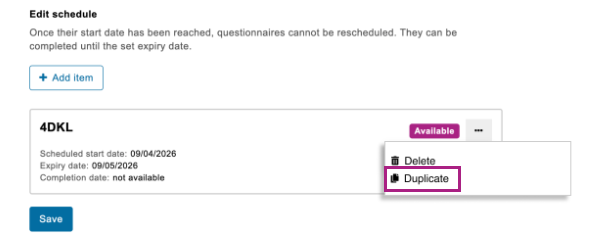
“Duplicate” button in “Edit Questionnaire Schedule”
Interested in the ROM functionality? Please contact your customer success manager for more information.
Content
Not less but better - Strengthening Digital Literacy
True to the motto “not less but better,” these new self-help modules help build digital literacy and the well-being that comes with it. These evidence-based training programs aim to help people spend their time online in a more mindful and healthy way. One exercise per day, mindfulness-based and body-oriented, offered in audio and text formats, promotes a reflective, self-determined approach to using digital devices.
Topics such as underlying needs, beliefs, impulse control, internal and external triggers, personal values, and “offline alternatives” are addressed. Practical concepts such as the habit loop, flow state, friction, and the Pomodoro Technique are introduced and applied through low-barrier exercises.
Some modules are available for ages 14 and up, while others are restricted to ages 18 and up.
In this release, the first modules for ages 14 and up will be available:
In the next release, the following modules will complete the series:
|  |
Interested in these modules? Contact your customer success manager for more information. There may be costs involved in using English-language content.
| Do you want to stay informed about developments? Sign up and receive the Release note every month. |